
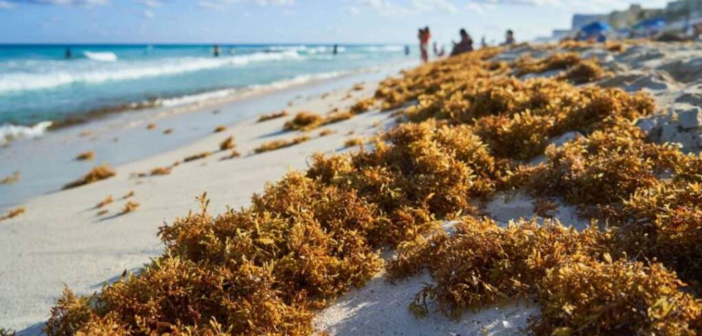
PR – In anticipation of a significant influx during the upcoming Sargassum season, the Ministry of the Blue Economy and Marine Affairs and the Ministry of Climate Resilience, Environment and Renewable Energy, in collaboration with the European Union Global Gateway Initiative and the International Trade Centre, are leading coordinated national efforts in sargassum management, policy development, and investment mobilisation to minimize its impact.
The establishment of the Grenada National Sargassum Taskforce (GNST) in September 2025, along with the Sargassum Secretariat, provides a structured national approach to stakeholder engagements, public-private partnerships, sargassum management, and valorisation. At a recent workshop, multi-stakeholder working groups formulated under the GNST were activated to immediately tackle the key challenges posed by sargassum head-on.
In addition to the institutional developments, the Ministry of the Blue Economy and Marine Affairs, in collaboration with the Grenada Solid Waste Management Authority, has engaged contractors in the affected coastal communities to conduct daily shoreline clean-up operations. Efforts will also be undertaken offshore to intercept sargassum before it reaches the shorelines. This will involve the use of vessels outfitted with pelagic (midwater) trawl nets, as well as oil containment booms, to trap and contain the seasonal influx of sargassum seaweed.
Parallel with these institutional developments, Grenada has advanced groundwork on the development of a Sargassum value chain under the EU Global Gateway Sargassum Valorisation Initiative. This initiative is designed to transform the challenges posed by sargassum influxes into economic and environmental opportunities.
As part of this initiative, on 5th February 2026, representatives from the Government of Grenada, the National Sargassum Task Force, the Grenada Solid Waste Management Authority, the EU and its Member States, the International Trade Centre, development partners and the private sector engaged directly with coastal communities through site visits to Soubise and Grenville Fish Market, grounding discussions in local realities and value-creation potential of sargassum. A thematic roundtable and strategic networking session then brought partners together to review progress and align policy, investment
and value-chain pathways – from collection and management to valorisation and market development – unpacking and prioritizing measures to effectively advance sargassum valorisation.
Together with the Ministry of Climate Resilience, The Environment & Renewable Energy, the Ministry of the Blue Economy and Marine Affairs, and the Ministry for Economic Development and Planning, Agriculture and Lands, Forestry, Marine Resources and Cooperatives, partners reaffirmed a shared commitment to: (i) Move from response to valorisation; (ii) Crowd in investment and innovation, and (iii) Build sustainable, inclusive value chains that strengthen economic resilience in Grenada – for improved food and energy security, coastal livelihoods and tourism.
Sargassum inundations have occurred in the Eastern Caribbean and Wider Caribbean since 2011 and are complex events that are still being understood. Responses are required at national, regional and international levels. Inundations of sargassum seaweed result in a wide array of issues. Careful coordinated responses are needed to protect public health in parallel with protecting marine and coastal environments.
Grenada envisions a resilient, climate-informed, and innovation-driven Sargassum System that protects public health and coastal ecosystems, strengthens the well-being and livelihoods of coastal communities, and transforms Sargassum into a strategic bioresource within a diversified and sustainable blue economy.

